As psychologists and, more importantly, as psychology students, we heavily rely on the peer-review process. When conducting an online search for journal articles that shall inform our next research project or assignment, we expect to find high-quality research right then and there. The peer-review process saves us time; we approach our search with the assumption that a large amount of articles that we find (at least those published in peer-reviewed journals) provide us with valuable insights into the area we are focussing on, even by just reading through the abstract. The reviewer is our friend! In this post I will offer some insight into my personal experiences regarding the peer-review process from the standpoint of the reviewer. More specifically I will highlight how I have systematically approached manuscripts that I was asked to review.
ACTA, SOPA, PIPA, RWA and what do they have to do with psychologists
These days, the news are full of acronyms dealing with various legislation concerning copyright. The problematic of copyright laws has long since left the geeky closet of the software community or the posh one of the poor and abused music industry. The acronyms in our title, familiar to most, are proof enough of their mainstream status. It is a central issue for the new generation, and everybody has an opinion on it. In this post, I would like to put the open access movement into that context, to see how it relates to the general public outcry regarding copyright legislation. Are these things connected? If yes, how?
A revolution in scientific publishing?
As many of our previous posts have already mentioned, the open access movement is growing steadily. Many academics try to fight companies that sell their scientific knowledge for enormous amounts of money. One of those publishing companies is Elsevier. Its recent increase of subscription fees lead to suggestions of a general boycott of Elsevier’s sources. Why Elsevier? Continue reading
Perfect references in no time: An introduction to free referencing software
A recent JEPS bulletin post revealed that the largest percent (37%) of APA style mistakes in the manuscripts submitted for the 4th issue of the Journal of European Psychology Students (JEPS) are related to reference formatting. This is consistent with the analysis of APA style mistakes from 2010 where the largest proportion of APA style mistakes in the past JEPS submissions were related to references as well, although in a significantly larger percent (51%).
As described in a previous post, writing proper references may involve several issues–correctly listing references cited in text, as well as having all references in the list cited in text. Problems also occur in correct spelling of the references, formatting in-text citations according to APA guidelines, formatting the reference list according to the specific APA rules applying to each type of publication and ordering the references alphabetically by the authors’ surnames.
Even though the APA manual is the guide no.1 in resolving these issues–doing it manually by the book requires a lot of time and attention. The good news is that there is a number of electronic tools that can also help to avoid these mistakes. This post offers you a brief introduction to two solutions–Zotero and Mendeley Desktop.
APA style: How to format the references list?
Referencing causes a great number of mistakes in APA formatting (see also our recent analysis of manuscripts submitted to JEPS). This is perhaps not surprising, given the amount of details a writer has to observe when enlisting a single item in the references list. Should the titles be capitalised throughout or not? What is in italics what is not? Where do commas and full stops go? Why is there a standardised way of reporting references in the first place?
Journals in Psychology
Journals in psychology, although most of them are not yet Open Access (optimistically speaking) as previous posts have indicated, function as working memory of scientific findings. They usually follow the idea of collecting and saving and commonly sharing findings that have been investigated qualitatively and quantitatively in the world and transmitting them worldwide and onto following generations. Although the idea of free access to most of the journals has not been fulfilled, journals nevertheless guide us through the quickly growing field of research. In order not to get too confused and overwhelmed by the mass of journals nowadays, this post intends to structure the journal world starting historically from the first and only journal in psychology established at the end of the 19th century. Continue reading
What happens to studies that accept the null hypothesis?
“The literature of social sciences contains horror stories of journal editors and others who consider a study worthwhile only if it reaches a statistically significant, positive conclusion; that is, an equally significant rejection of a hypothesis is not considered worthwhile” (Scargle, 2000).
This is a footnote in Jeffrey D. Scargle’s, an astrophysicist working for NASA, article about the publication bias in scientific journals. Usually, the psychologist in me would go all defensive of our precious little social science, but then one discovers this: a couple of researchers trying to publish a paper debunking Bem’s research on ESP (in layman terms, ESP means predicting the future). More precisely, their woes while trying to publish a paper with nonsignificant results. How many papers have you read that have nonsignificant results, that accept the null hypothesis? I have a feeling you have the same answer as me, and it’s frighteningly converging on zero. What happens to those papers? And what’s the implication of such a bias in publishing for science at large?
How to format headings in APA Style?
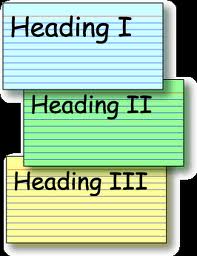
Students encounter problems with formatting headings according to the APA Style surprisingly often. 9% of manuscripts of submitted to the Journal of European Psychology Students manifested a problem in that area (Vainre, 2011). Even though compared to the previous version of the manual, the APA has simplified its standards considerably, much confusion still seems to be there. Hopefully this post will clarify a thing or two.
Continue reading
How to search for literature?
One of the first skills we learn at the beginning of our university career is how to search properly for psychological literature. It reflects one of the first steps we employ conducting a psychological study and follows us throughout the entire research procedure when looking for additional knowledge.
The longest journey starts with a single step. A researcher would rather state: The longest research starts with a multiple literature search. Have you wandered from one database to the other desperately looking for a place to start with? Or do you never know when to end your search?
Research as an international project
As a psychology student you have to face certain barriers, when you have the possibility to do research. Those barriers mostly concern the university you are studying at. If your university does not provide you the opportunity to research in a field of your interest, the chance of working in an international research team on a joint project might be a good option to develop your research skills and discover the world of academia on an international level. If you can find such a team, then you are lucky, because 1) it is great to work together with people from different cultures who are all interested in the same topic and can share their expertise 2) it gives you possibilities to work on aspects of a topic that you could not do within the cultural and methodological framework of just one university.
But the opportunity of an international research team reveals some challenges you will have to face at several critical points throughout your work. In the following post, those challenges are summarized.